

Spoiler warning: This recap discusses the full premiere of Treasure Island, including Billy Bones’ death, the destruction of the treasure map, and the final reveal aboard the Hispaniola.
The first episode of MGM+’s Treasure Island, titled “The Admiral Benbow,” does more than modernize Robert Louis Stevenson’s pirate adventure. It changes who holds the power, how the treasure hunt begins, and why Jim Hawkins becomes essential to the journey. The result is a story in which Jim and his mother, Bess, are not simply swept into a pirate mystery: they make choices that pull them directly into it.
Below is a spoiler-filled breakdown of the premiere’s biggest changes from Stevenson’s 1883 novel, and what each one means for the series ahead.

1. Jim Hawkins has a photographic memory
The most consequential new idea is Jim’s near-perfect memory. In the series, Bess uses his ability to win wagers, including contests involving Bible verses. It is a practical survival strategy for a family under financial pressure, but it also plants the key to the entire adventure.
In Stevenson’s novel, Jim is observant and resourceful, but the book does not give him a superhuman photographic memory. The show turns a familiar coming-of-age trait—paying attention—into a specific plot mechanism. Once Jim studies Flint’s map, its destruction no longer means the treasure’s location is necessarily lost.
Why it matters: Jim is not valuable only because he is the boy who discovers a pirate’s secret. His mind becomes the one copy of information that the other characters cannot simply steal or burn.
2. Bess Hawkins is a central decision-maker

The adaptation gives Jim’s mother, Bess Hawkins, a much larger dramatic role. She helps run the Admiral Benbow, makes calculated decisions to keep the household afloat, and sees the treasure as a possible escape from financial insecurity. Her choices help drive the plot instead of leaving her on the margins of Jim’s story.
Stevenson’s novel places Jim at the center and gives his mother a much smaller part in the opening chapters. The series’ expanded Bess changes the emotional stakes: the voyage is not only a boy’s adventure, but also a mother’s risky attempt to secure a different future for her child.
That change also makes Bess’s decisions more complicated. She can be resourceful and protective while still being tempted by the possibility of wealth. The premiere asks viewers to consider whether she is acting out of courage, desperation, ambition—or all three.
3. Billy Bones reveals the treasure story earlier
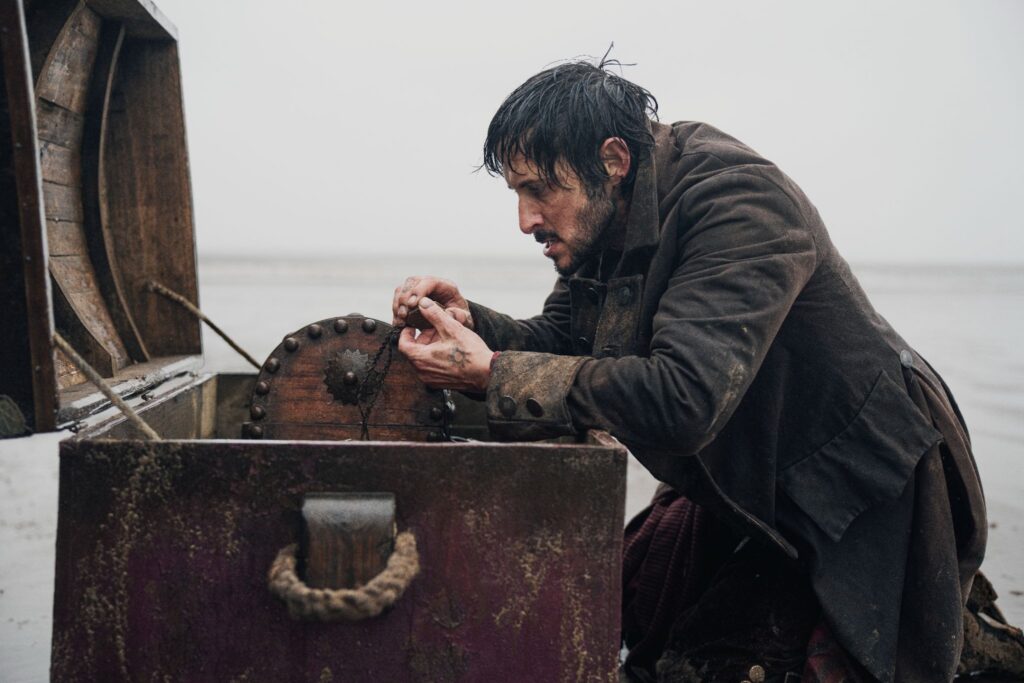
In the novel, Billy Bones arrives at the Admiral Benbow carrying the threat of his past, but the story unfolds through Jim’s gradual discovery of the pirates’ world. The television version makes the treasure’s history more explicit in the premiere. Billy explains his connection to Captain Francisco Flint and the fortune hidden on Skeleton Island, giving Bess and Jim a clearer reason to get involved.
The show also develops a personal connection between Billy and Bess. That attraction adds a layer of emotional risk to what might otherwise be a straightforward exchange of information and money. Bess is not just assessing a stranger’s story; she is responding to a man who appears to offer both danger and possibility.
This is a substantial tonal change. The map remains the plot’s engine, but relationships and financial pressure make the decision to pursue it feel more immediate.
4. Long John Silver enters the story as an immediate threat
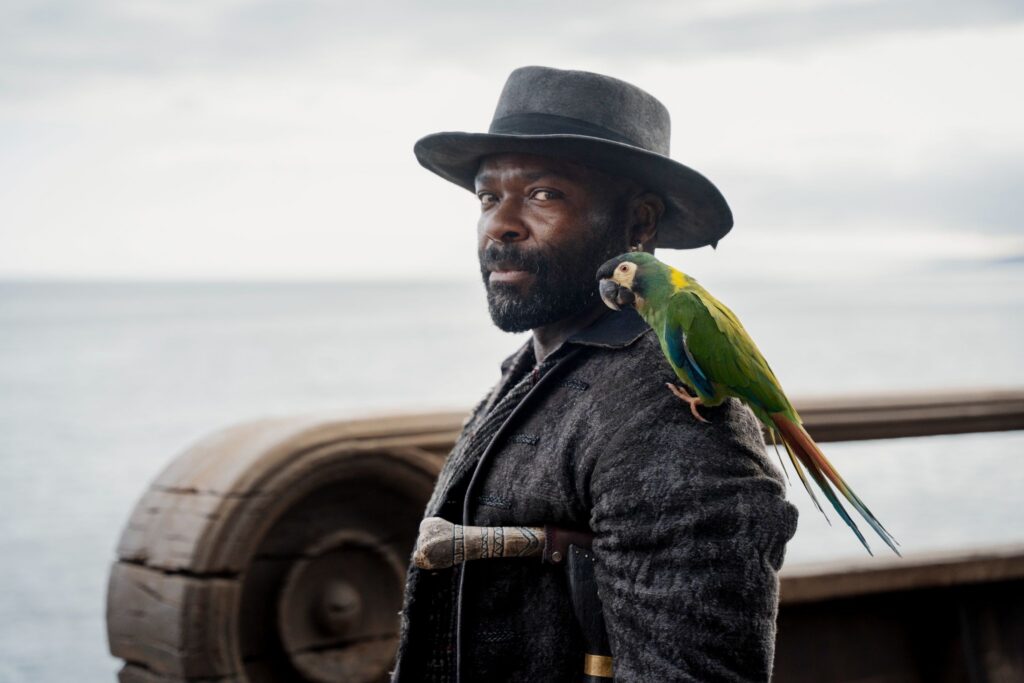
Silver is a legendary character in the novel, but the series frames him as a direct and unsettling danger from the outset. The opening shipwreck imagery establishes the rivalry between Silver and Billy before the story settles into the inn. His pursuit of the map then becomes a pressure that follows the Hawkins family into every major decision.
David Oyelowo’s portrayal also steers away from a purely theatrical, comic-book pirate. Silver is controlled and intimidating, with the threat coming as much from his stillness as from his violence. The adaptation uses that approach to give the story a darker, more suspense-driven mood.
The key difference: Silver is not merely a name associated with the treasure hunt. He is a danger the characters can see coming—and still cannot easily escape.
5. Bess burns the map—but Jim has already memorized it
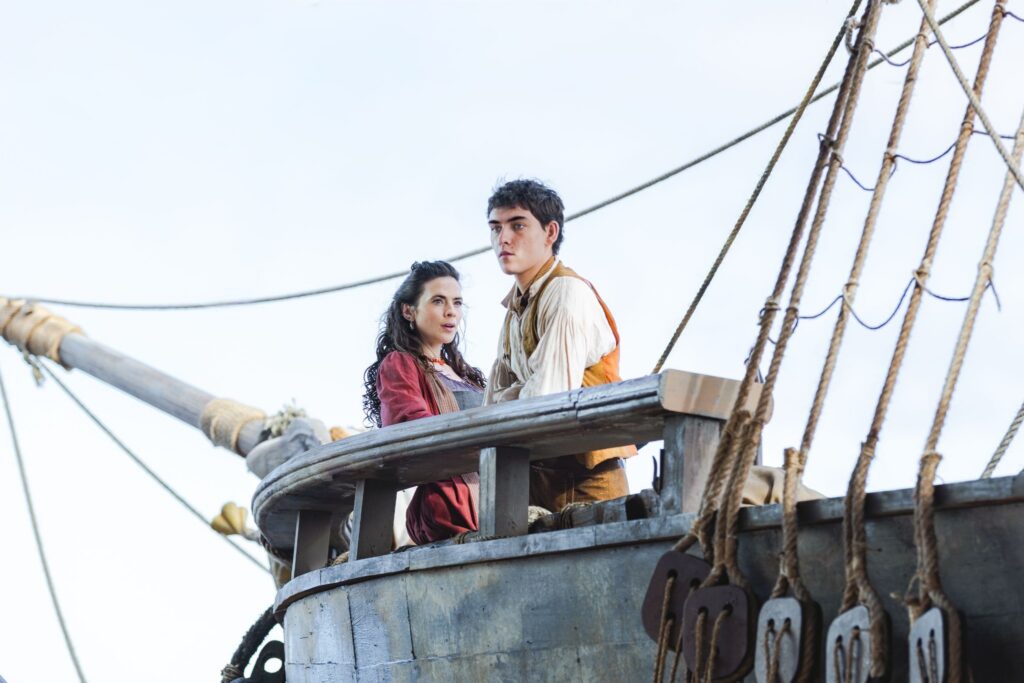
This is the premiere’s most important plot change. In the series, Jim studies the map and commits its details to memory. During the confrontation involving Billy, Silver, and Squire Livesey’s men, Bess burns the physical map rather than allow it to remain in other people’s hands. Billy is fatally wounded in the chaos, leaving Jim and Bess with a secret they may be able to protect.
Stevenson’s novel handles the map differently. Jim and his mother retrieve papers from Billy Bones’ sea chest after his death, and the map becomes the document that draws the larger expedition together. The TV version turns the destruction of the map into a deliberate act—and gives Jim’s memory a concrete payoff.
The move is clever but dangerous. Jim may remember the route, yet memory does not guarantee that he can navigate an unfamiliar island, persuade a crew to trust him, or keep Silver from forcing the information out of him. The paper is gone; the danger is not.
6. The Hispaniola reveal becomes a cliffhanger about trust
After the violence at the inn, Jim and Bess set out to reach the ship that can take them toward the treasure. They board the Hispaniola, where Captain Smollett introduces the ship’s cook: Long John Silver. The man they hoped to leave behind is now close enough to control their daily lives.
Silver’s role as the Hispaniola’s cook is drawn from Stevenson’s original story, but the series gives the reveal a particularly sharp function. Jim and Bess arrive aboard with a secret advantage, while Silver is positioned to watch them and search for the map’s location. Each side needs something from the other, and neither can safely reveal how much they know.
The closing twist also shifts the adventure from a mystery at a coastal inn to a contained survival story at sea. There is nowhere easy to run, and every meal, conversation, and routine encounter can become part of the contest.
What the premiere keeps from the original novel
Despite its changes, the series retains several core pieces of Stevenson’s story: the Admiral Benbow, Billy Bones, Captain Flint’s buried treasure, Skeleton Island, Jim Hawkins, Long John Silver, and the Hispaniola. Silver’s position as the ship’s cook remains especially important, as does the idea that a treasure map can make ordinary people targets for dangerous men.
The adaptation changes the route into the adventure more than it changes the destination. Jim’s memory and Bess’s expanded role are new engines for the plot, but the underlying conflict remains recognizable: the promise of wealth brings together people whose motives are not the same.
Every major change at a glance
| Story element | 2026 TV adaptation | Stevenson’s novel |
|---|---|---|
| Jim’s memory | Near-perfect photographic memory drives the map plot. | Jim is observant, but no supernatural-like memory is established. |
| Bess Hawkins | A major character with her own financial and emotional stakes. | A much smaller role in the opening chapters. |
| Billy’s explanation | The treasure’s history is made explicit early. | The mystery unfolds more gradually through Jim’s discoveries. |
| The map | Bess burns it after Jim memorizes it. | The map survives and helps set the expedition in motion. |
| Silver’s threat | Presented as a direct danger from the opening sequence. | Jim’s knowledge of Silver develops later in the narrative. |
| Premiere ending | Jim and Bess discover Silver is aboard the Hispaniola as cook. | Silver’s role as ship’s cook is also central to the original plot. |
Does the new version improve Treasure Island?
The premiere’s strongest change is the way it connects Jim’s gift to the central mystery. The map-burning scene would be a dead end in a more conventional version; here, it becomes a reason Jim matters to every person chasing the treasure. Bess’s expanded role also gives the story a family drama that can sit alongside the pirate adventure.
The risk is that added abilities and heightened relationships can crowd out the simplicity of Stevenson’s original: a young narrator, a dangerous secret, and a journey that reveals what people are willing to do for money. Whether the series balances those elements will depend on how it develops Jim and Bess beyond the premiere.
For now, the final reveal is effective because it makes the next question unavoidable: if Silver knows Jim and Bess are aboard, how long can they keep the map’s location—and their real intentions—secret?
Frequently asked questions
What is Treasure Island Episode 1 called?
The premiere is titled “The Admiral Benbow.” It introduces Jim and Bess Hawkins, Billy Bones, the treasure map, and Long John Silver.
Does Bess burn the treasure map in the new Treasure Island?
Yes. Bess destroys the physical map during the confrontation at the inn, but Jim has already memorized its details, preserving a way to find the treasure.
Is Jim Hawkins’ photographic memory in the original book?
No. The photographic-memory concept is a change made for the 2026 television adaptation. It gives Jim a new, direct connection to the treasure-map plot.
Why is Long John Silver on the Hispaniola at the end?
Silver has joined the ship’s crew as its cook. The reveal places him close to Jim and Bess, even though they know he is dangerous and he wants access to the treasure information.
Where can I read the original Treasure Island?
Robert Louis Stevenson’s novel is available to read through Project Gutenberg’s public-domain edition.
Sources and further reading
- Paramount+ UK & Ireland: Treasure Island — cast, premise, first-look images, and production details
- Robert Louis Stevenson, Treasure Island — full text at Project Gutenberg
- Ready Steady Cut: Episode 1 recap and review
- FandomWire: Episode 1 recap
Image note: The stills above are hosted by Paramount+ UK & Ireland and credited to the series’ official first-look material. Confirm the rights and permitted use for your store and territory before relying on third-party hosted promotional images long-term.
By Shivam Das


