

By Shivam Das
Robert Louis Stevenson’s Treasure Island has survived more than a century of changing film technology, shifting ideas about childhood, and very different interpretations of Long John Silver. The story began as a magazine serial in 1881–82 before appearing as a book in 1883. Since then, filmmakers and television producers have returned to Jim Hawkins, the Hispaniola, the treasure map, and Silver’s uneasy mix of charm and danger.
Quick answer: The best-known screen milestones include the 1934 MGM sound film, Disney’s 1950 live-action classic, the 1972 Orson Welles version, the 1990 television movie with Charlton Heston and Christian Bale, Muppet Treasure Island (1996), the space-opera reimagining Treasure Planet (2002), the 2012 television adaptation, and MGM+/Paramount+’s six-part 2026 reimagining. Earlier silent films and international versions are important parts of the history too—although some are lost or difficult to find today.

Before the movies: The novel that made the map famous
Stevenson’s story first appeared in the magazine Young Folks under the title Treasure Island, or the Mutiny of the Hispaniola, running from 1881 to 1882. The book edition followed in 1883. Its ingredients proved remarkably adaptable: a young narrator, a map, a voyage, a divided crew, and a pirate who can be both frightening and strangely likable.
That flexibility is the key to the adaptation timeline. Some versions focus on a boy’s coming-of-age story; others emphasize mutiny, comedy, family adventure, or the moral ambiguity of Silver. A few preserve the novel’s period atmosphere, while others move the treasure hunt into entirely new worlds.

1918 and 1920: The silent-film beginnings
A 1918 Fox Film Corporation adaptation is among the earliest major American screen versions documented by the American Film Institute. A 1920 version directed by Maurice Tourneur followed, with Shirley Mason playing Jim Hawkins—a striking casting choice for a character traditionally presented as a boy. The 1920 film is generally considered lost, which means modern audiences cannot easily compare its performances or visual style with later versions.
These early films arrived when cinema was still developing its language for action and adventure. Intertitles, expressive acting, and visual staging had to carry the story without synchronized dialogue. Even when the films themselves are unavailable, their existence shows how quickly the novel became screen material.
1934: MGM brings Treasure Island to sound cinema
Victor Fleming’s 1934 MGM adaptation, starring Wallace Beery as Long John Silver and Jackie Cooper as Jim Hawkins, became the first widely recognized sound-film version of the novel. Lionel Barrymore also appeared as Billy Bones. The move from silent storytelling to spoken pirate dialogue changed the experience: Silver’s personality could be expressed through voice, timing, and verbal charm as well as action.
_01.jpg "Treasure Island 1934 MGM theatrical poster")
1937: An international reimagining
The Soviet film Treasure Island, directed by Vladimir Vaynshtok and often dated 1937 or 1938 in reference sources, took the story in a different direction. Its political and romantic elements diverged from a straightforward retelling, demonstrating that adaptations can use Stevenson’s framework to reflect the culture and concerns of their own time.
1950 and 1954: Disney’s landmark and the return of Long John Silver
Disney’s Treasure Island premiered in 1950, with Bobby Driscoll as Jim and Robert Newton as Silver. It was Disney’s first fully live-action feature film and helped establish a vivid, colorful visual template for pirate adventure. Newton’s performance became especially influential: his delivery helped popularize a recognizable screen-pirate style that later productions would echo, parody, or deliberately reject.
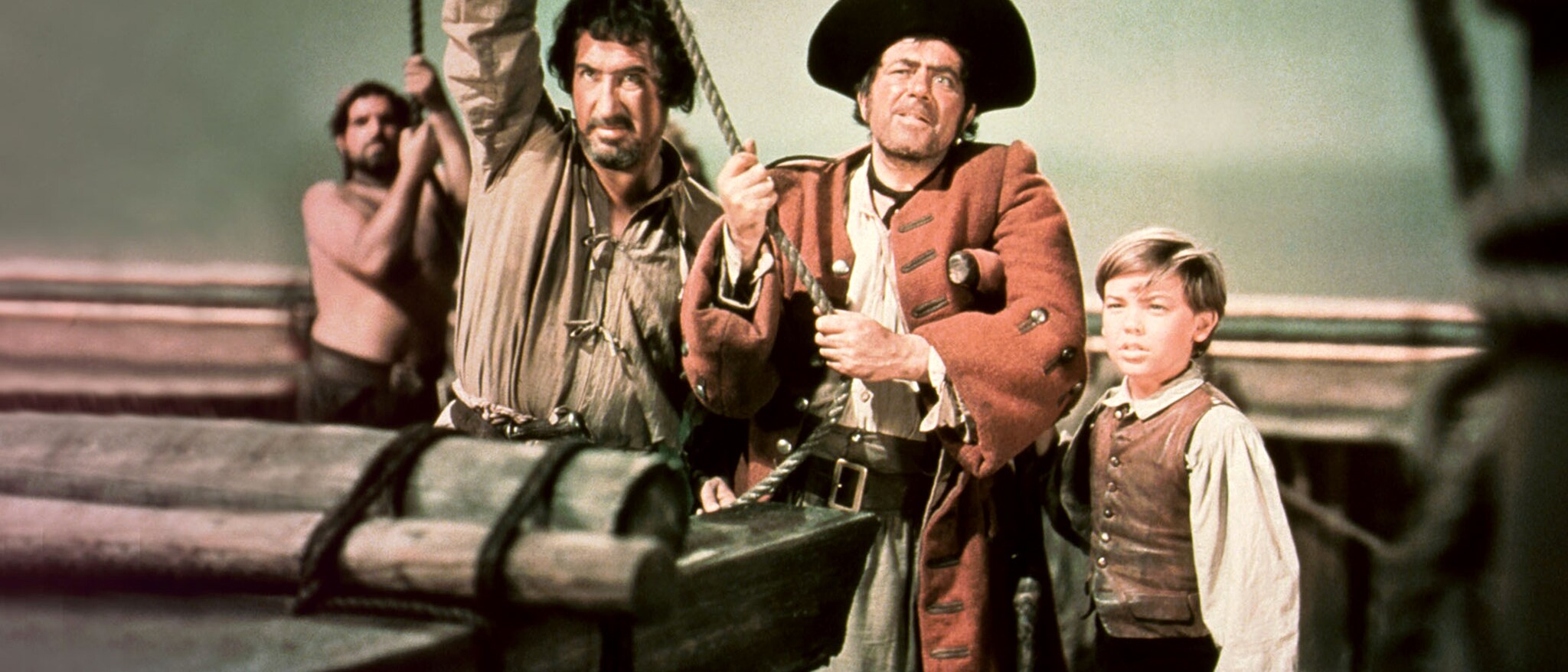
Newton returned as Silver in the Australian feature Long John Silver (1954), which continued the character’s adventures rather than simply repeating the original novel. A television series, The Adventures of Long John Silver, followed in the 1950s. These projects show how a compelling antagonist can become the center of a franchise of his own.
1960s–1980s: Television, animation, and international versions
The story kept moving between formats. A German television miniseries appeared in 1966, while later decades brought television productions, animated versions, and adaptations from Japan, the Soviet Union, and other countries. The 1972 live-action film featured Orson Welles as Silver; a 1973 animated version used voice performances and stylized action to reach a different audience.
The Japanese animated series Takarajima (1978), known in English as Treasure Island, became one of the best-known animated interpretations. Its extended format allowed the voyage and crew relationships to develop over many episodes rather than being compressed into a feature film. Other animated adaptations in the 1980s further proved that the novel’s essential conflict worked beyond live-action period drama.

1990: Charlton Heston and Christian Bale
The 1990 television movie directed by Fraser Clarke Heston starred Charlton Heston as Long John Silver and Christian Bale as Jim Hawkins. Its ensemble also included Oliver Reed and Christopher Lee. For many viewers, this version offered a more traditional, live-action interpretation of the novel, with a strong emphasis on the dangerous bargain between Jim and Silver.
1996: Muppet Treasure Island makes the classic funny again
Brian Henson’s Muppet Treasure Island paired the Muppets with human performers including Tim Curry as Long John Silver, Billy Connolly as Billy Bones, and Jennifer Saunders as Mrs. Bluveridge. Its comedy does not erase the original’s themes of greed, loyalty, and betrayal; it makes those themes accessible through musical numbers, visual jokes, and a knowingly theatrical tone. Curry’s Silver is a useful example of how the same character can be threatening and entertaining at once.
1999–2012: Television adventures and a return to the source
The late 1990s brought another television-film adaptation featuring Kevin Zegers and Jack Palance. In 2002, Disney released Treasure Planet, which transferred the adventure into science fiction. Jim became a spacefaring teenager, sailing ships became spacecraft, and Silver was reimagined as a cyborg-like figure. The setting changed dramatically, but the story’s emotional engine—an uncertain young hero drawn toward a charismatic and dangerous mentor—remained recognizable.
A 2012 British television adaptation directed by Steve Barron featured Eddie Izzard as Silver, Toby Regbo as Jim, Donald Sutherland as Flint, and Elijah Wood as Ben Gunn. Its longer runtime gave the production room to explore political intrigue and the adult world around Jim. It also reflected a recurring adaptation strategy: expand the supporting characters and the world surrounding the treasure, rather than treating the map as the whole story.
2026: MGM+ and Paramount+ reimagine the Hawkins family
The 2026 six-part Treasure Island is a new US–UK production from Playground, presented as an MGM+ original in the United States and a Paramount+ original in the United Kingdom and Ireland. The cast includes Tom Sweet as Jim Hawkins, Hayley Atwell as Bess Hawkins, David Oyelowo as Long John Silver, Jack Huston as Aaron Graham, and Tomer Capone as Billy Bones. The series expands Bess’s role and gives Jim an exceptional memory, making the family’s decisions central to the treasure hunt.
Those changes create a useful comparison with earlier versions. The 1950 Disney film is remembered for its classic swashbuckling tone and Robert Newton’s Silver; Muppet Treasure Island leans into comedy; Treasure Planet relocates the coming-of-age story to space. The 2026 version uses a serialized format to foreground family, power, and the risks of trusting the wrong ally. Whether those choices work for every viewer is a matter of taste, but they show that the novel still invites reinterpretation.
Paramount+ UK & Ireland announced a 12 October 2026 launch in that territory, while the US premiere was scheduled for 11 October 2026 on MGM+. The difference reflects separate regional release plans rather than two different series.
Official trailer: Treasure Island (2026)
Watch the official trailer for the 2026 adaptation below. The trailer is an official promotional video; it is not a substitute for the full episodes.
Which adaptation should you watch first?
For a classic studio adventure, start with Disney’s 1950 film. For a playful family version, choose Muppet Treasure Island. For a science-fiction reinvention, watch Treasure Planet. If you want a traditional television take with a notable father-and-son casting connection, the 1990 film is worth seeking out. The 2026 series is the option for viewers who want a longer, contemporary reworking that gives Bess Hawkins more agency.
The best version ultimately depends on what you value: fidelity to Stevenson, a memorable Silver, period atmosphere, comedy, or bold reinvention. The story has lasted because those priorities can change without making the treasure map any less tempting.
Frequently asked questions
What was the first Treasure Island movie?
Several early versions appeared in the silent era. The American Film Institute documents a Fox Film Corporation adaptation released in January 1918; a 1920 version followed but is generally considered lost.
Was Disney’s 1950 Treasure Island its first live-action film?
Yes. Disney and the Walt Disney Family Museum identify the 1950 film as the studio’s first fully live-action feature film.
Is Muppet Treasure Island based on the same novel?
Yes. The 1996 musical comedy adapts Stevenson’s novel but adds Muppet characters, comedy, and songs.
Is Treasure Planet part of the Treasure Island adaptation timeline?
Yes. The 2002 animated science-fiction film reimagines the novel’s central characters and coming-of-age adventure in a space setting.
What makes the 2026 Treasure Island different?
The six-part adaptation expands Bess Hawkins’s role and gives Jim an exceptional memory, emphasizing family dynamics and the struggle over who controls the treasure map.
Sources and further reading
- American Film Institute: Treasure Island (1918) and adaptation history
- AFI Catalog: MGM’s 1934 Treasure Island
- The Walt Disney Family Museum: Disney’s first live-action feature
- Disney Movies: Treasure Island (1950)
- Paramount+ UK & Ireland: Treasure Island (2026) cast, release and production details
- The Robert Louis Stevenson Archive: Film versions of Treasure Island
Image note: Historic illustrations and posters are credited to their source pages. Rights for commercial reuse should be checked for each image and territory before publication.


_01.jpg)
