

Updated October 16, 2026 | By Shivam Das
Tesla’s long-delayed next-generation Roadster has finally delivered the spectacle that kept its “flying car” promise alive. At an October 15 demonstration in Texas, a prototype climbed a curved ramp, traveled upside down, briefly lifted into the air and used thrusters to rotate before landing. The display was real enough to reignite interest—but it does not mean buyers can soon drive a production car that freely flies over public roads.
Reuters and The Verge reported that the demonstration combined a fan-based suction system with compressed-gas thrusters developed with SpaceX. Tesla has targeted production for 2028, so the prototype’s performance should not be confused with a certified, customer-ready vehicle. Read Reuters’ event report and The Verge’s demonstration recap.
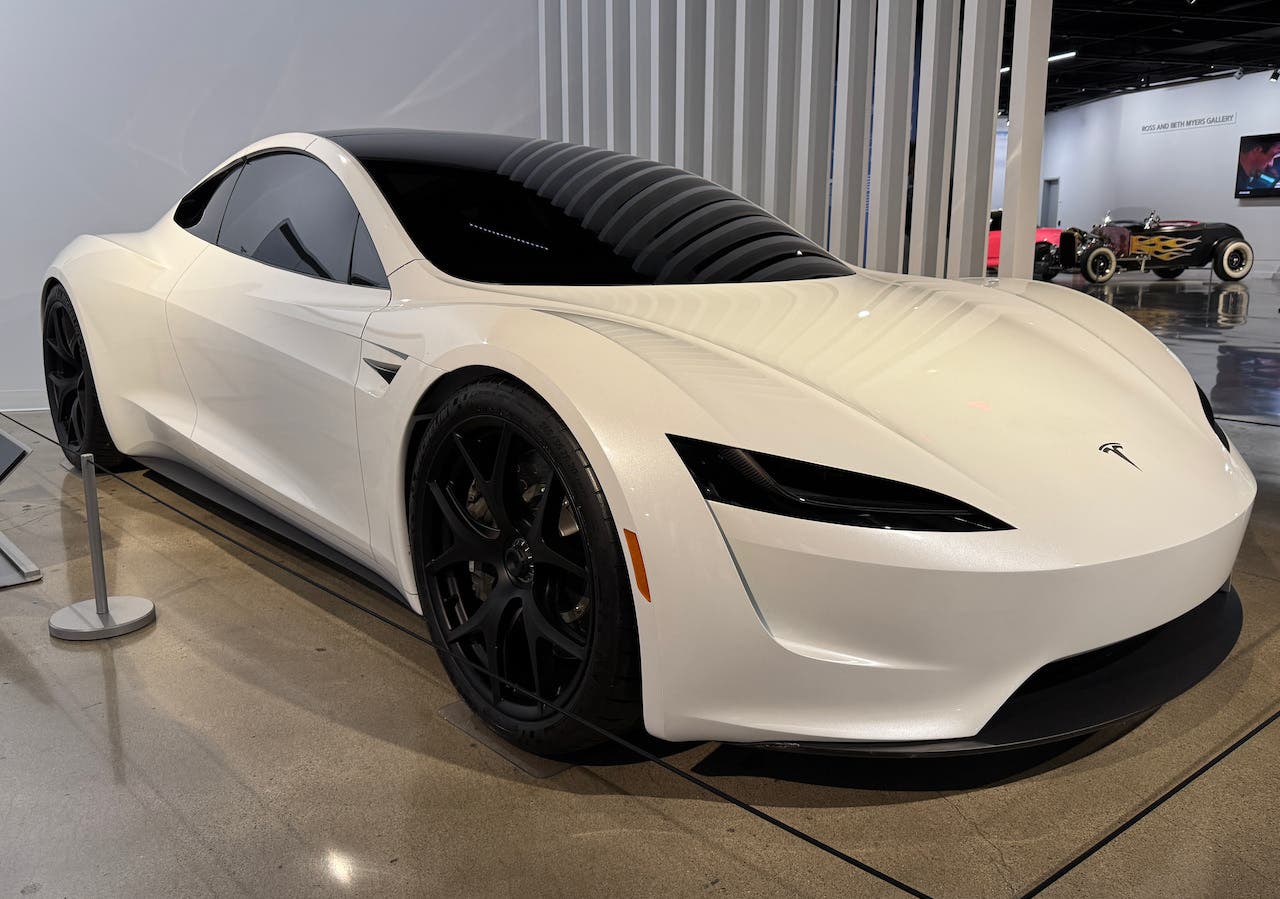
What the Texas demonstration actually showed
The Roadster climbed a steep, curved ramp and remained inverted before leaving the structure and rotating in midair. In a second stunt, it jumped over a row of Tesla vehicles. The system combines fans that create suction beneath the car with cold-gas thrusters that help control its attitude during the brief flight. Tesla engineering executive Lars Moravy described the suction system during the presentation; independent road testing of a production version has not established how these systems would work outside a controlled demonstration.
This was a staged prototype demonstration, not evidence that a regular road-going vehicle can safely take off and land wherever its driver chooses. Coverage reported that the stunts were performed without a person driving inside the car. Road legality, safety certification, operating limits and production hardware remain open questions.
How SpaceX-style thrusters could work
Cold-gas thrusters create force by releasing stored pressurized gas through nozzles. Spacecraft use similar principles to adjust orientation without conventional aerodynamic control surfaces. On the Roadster prototype, Tesla paired thrusters with a suction system designed to keep the vehicle pressed against a specially built ramp before the airborne sequence.
The demonstration leaves practical questions unanswered: how much compressed gas a production car would carry, how often the system could be used, what it would do to weight and range, and what safety systems would be required. Those details matter more to future owners than the spectacle of a single successful stunt.
What is known—and what is not—about performance and price
During the reveal, Tesla presented an acceleration run that it said reached 60 mph in less than one second. That is a company demonstration claim, not an independently verified consumer test. Reports describe a top-speed target above 230 mph and a range of more than 300 miles, while final production specifications remain subject to confirmation.
Reported reservation options include a Performance version with a $50,000 deposit, a Thrust version with a $250,000 deposit, and an invite-only Rocket configuration. These are reservation deposits, not the full purchase price. Reuters reported that Tesla did not announce a definitive retail price at the event. Buyers should not treat old estimates or deposit amounts as a confirmed final MSRP.

The design story behind the new Roadster
The new car looks markedly different from the red second-generation concept Tesla first showed in 2017. That earlier reveal set ambitious expectations for acceleration, top speed and range, but the program missed several projected production dates. The October demonstration gives the project a more tangible public moment; it does not erase the delivery history or guarantee the 2028 target will hold.
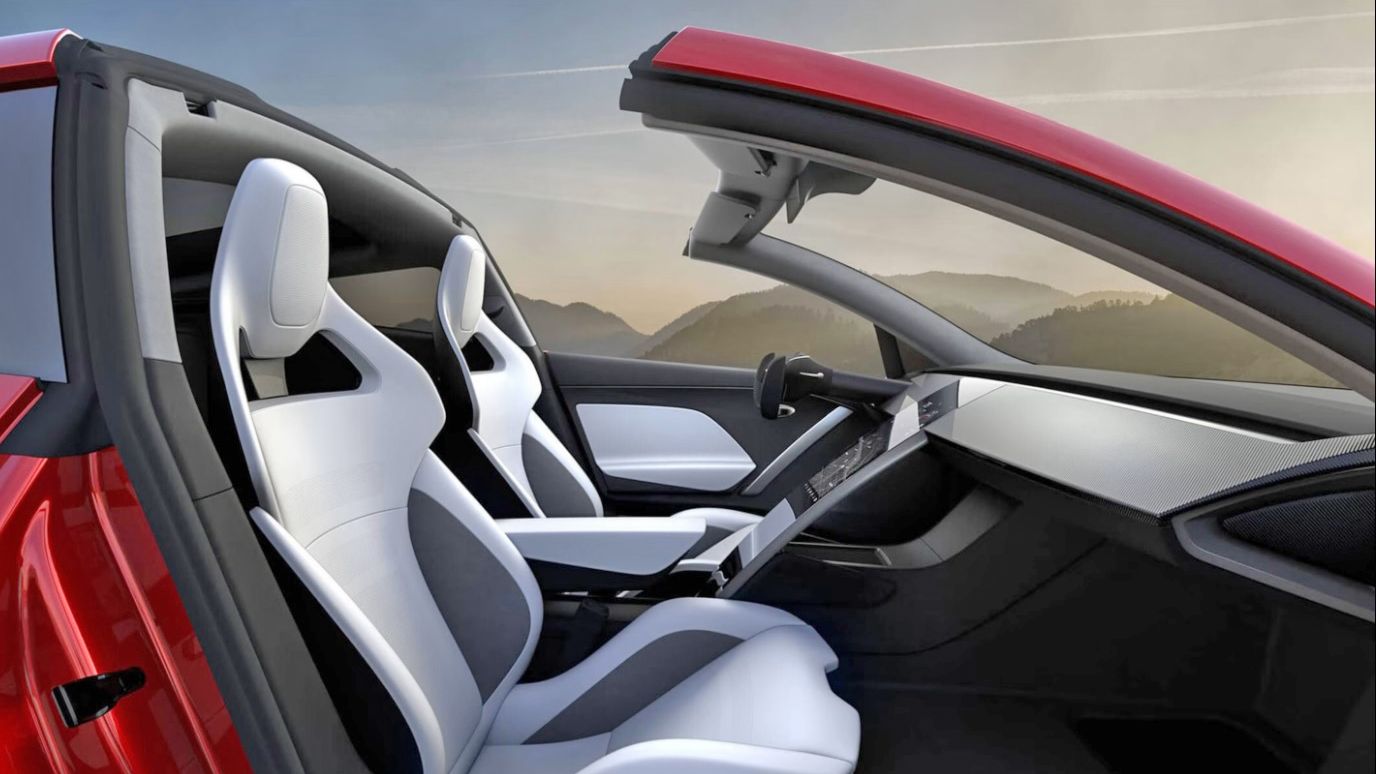
The original 2017 reveal also explains why the latest stunt generated so much attention. Tesla made ambitious promises years ago, and the Roadster became a symbol of both engineering ambition and delays. The next meaningful proof will be a production specification, independent testing and a credible delivery schedule.
Watch original event coverage
For continuing updates, use original reporting rather than reposted clips without context. Tesla’s Roadster page is the official product reference, while TechCrunch’s report summarizes the demonstration and its caveats. Tesla’s official X account has also posted event-related clips; check the account for the original posts and current embed availability.
Quick answer: Is the Tesla Roadster a real flying car?
Not in the everyday sense—not yet. Tesla demonstrated a prototype that briefly lifted and rotated using a special ramp, suction fans and compressed-gas thrusters. Production is targeted for 2028, but final specifications, retail pricing, certification and real-world operating limits still need confirmation.
Frequently asked questions
When did Tesla demonstrate the thruster-equipped Roadster?
The demonstration took place on October 15, 2026, at a SpaceX test site in Texas.
Can the Tesla Roadster fly over public roads today?
No. The event showed a prototype performing controlled stunts in a prepared setting. It does not establish that the vehicle is approved for flight or legal to use that way on public roads.
When is the new Tesla Roadster expected to enter production?
Tesla has indicated a 2028 production target. A target is not a guarantee of customer deliveries on a specific date.
How much will the Tesla Roadster cost?
Tesla did not confirm a final retail price at the reveal. Reservation deposits are not the vehicle’s full purchase price.
What powers the Roadster’s flying demonstration?
The prototype used a fan-based suction system to adhere to a curved ramp and compressed-gas thrusters to control its movement during brief airborne maneuvers. The final production setup still needs confirmation.
Reporting note: Performance figures and production timing are attributed to Tesla or published reporting where indicated. Demonstration claims should not be treated as independently certified specifications.






