

By Shivam Das | October 13, 2026
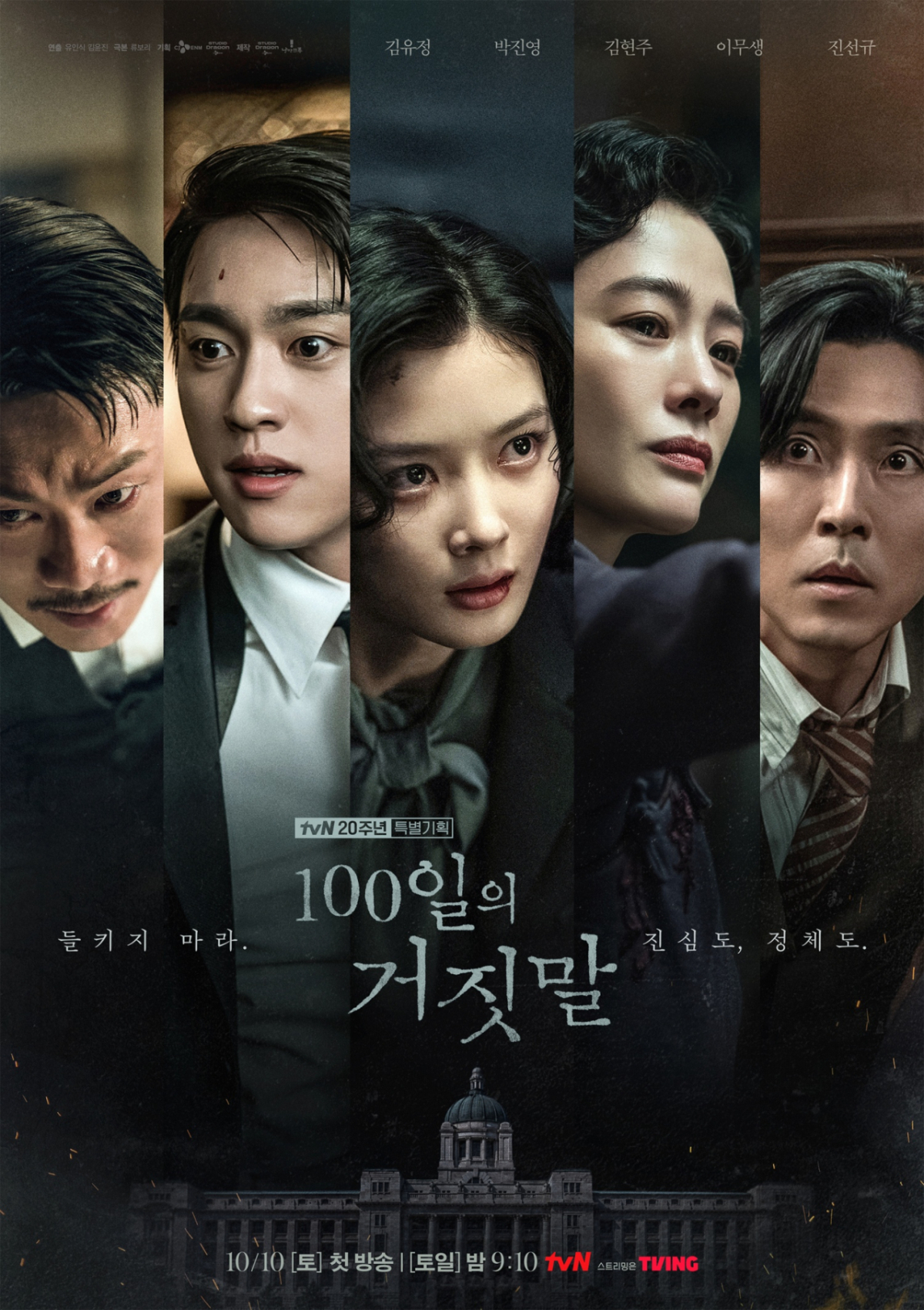
In tvN’s historical spy romance 100 Days of Deception, Park Jin-young’s most effective moments are often the ones that do not announce themselves. A held look, a measured response, or a pause before he answers can make his character, Sato Hideo, feel difficult to read—and that uncertainty is central to the drama’s appeal.
That does not mean Kim You-jung is being outperformed. Her Lee Ga-kyung drives the story with quick instincts and the restless alertness of a pickpocket turned undercover operative. The contrast is what makes their scenes work: Ga-kyung moves as if every second might expose her, while Hideo often appears to have time to study the room. The tension between those approaches gives the early episodes much of their spark.

Why Park Jin-young’s restraint matters
Hideo is not simply a romantic lead waiting for the next flirtatious exchange. He works as an elite interpreter inside the Japanese colonial administration and carries a complicated identity of his own. The character’s position requires him to listen carefully, manage what he reveals, and notice details other people miss. A restrained performance therefore suits the role: too much visible emotion could make Hideo easier to understand than the story intends.
Park’s quietness also gives the scenes a useful rhythm. When Ga-kyung tries to improvise her way out of trouble, Hideo’s stillness becomes a kind of counterpressure. The audience has to watch both characters, not just wait for the next line. It creates the sense that every conversation may be an interrogation disguised as ordinary talk.

Kim You-jung gives the story its momentum
Calling Park’s performance a scene-stealer should not erase the work Kim is doing. Ga-kyung is a pickpocket recruited into an undercover mission for the Korean independence movement. She has to perform confidence while constantly calculating risk. Kim’s quick changes in expression help communicate that double task: Ga-kyung can appear cheeky one moment and intensely watchful the next.
The strongest scenes depend on that difference. If both characters were openly expressive, the cat-and-mouse dynamic would lose some of its uncertainty. If both were distant, the romance could feel cold. Instead, Kim supplies movement and improvisation while Park supplies friction and ambiguity. The chemistry comes from the gap between them, not from one actor simply winning every scene.

The historical setting raises the stakes
The series is set in Gyeongseong in 1932, during Japanese colonial rule. Ga-kyung’s mission places her inside the Government-General, while Hideo’s role as an interpreter puts him close to power. Their personal uncertainty unfolds against a setting where language, allegiance, and identity can have serious consequences. That context makes the characters’ careful exchanges more than a familiar romantic game.
The premise also creates an interesting tension for viewers: a character can be useful to the mission and still be emotionally difficult to trust. Hideo’s quiet intensity is compelling because the audience cannot assume that silence means indifference—or that a moment of warmth proves loyalty. The story has room to make both possibilities matter.
What the early ratings tell us—and what they do not
Episode 2 reportedly reached a 7.6% nationwide average, with a reported peak of 9.4% in the Seoul metropolitan area. Those figures suggest a promising early response, but they do not prove that one actor or one scene caused the increase. Ratings can reflect the premise, scheduling, promotion, audience word of mouth, and the performance of the full ensemble.
The more useful question is whether the drama can keep turning its setup into meaningful character choices. Viewers may enjoy the push-and-pull between Ga-kyung and Hideo, but suspense needs consequences. If each encounter changes what the characters know, risk, or believe about one another, the chemistry can develop rather than repeat the same beat.

Watch the official drama coverage
For a first-party look at the production, see the official tvN press-event video below. Availability and playback may vary by region.
Official series information is available from Netflix, and a recent episode preview was covered by Soompi.
Quick answer: Is Park Jin-young stealing the show?
He is making a strong impression through restraint, timing, and ambiguity, but the drama works best as a two-lead performance. Kim You-jung supplies the urgency that makes Hideo’s calm difficult to ignore. Their contrasting styles—not a clear contest between actors—are the main reason their scenes are engaging.
Frequently asked questions
Who does Park Jin-young play in 100 Days of Deception?
He plays Sato Hideo, an elite interpreter connected to the Japanese colonial administration who becomes entangled with undercover operative Lee Ga-kyung.
Who plays Lee Ga-kyung?
Kim You-jung plays Lee Ga-kyung, a skilled pickpocket recruited for an undercover mission connected to the Korean independence movement.
Why is Park Jin-young’s performance attracting attention?
His controlled delivery and guarded reactions create uncertainty around Hideo’s motives, which suits a story built around secrets, identity, and espionage.
Did Park Jin-young alone cause the ratings increase?
No available rating figure can establish that. Ratings reflect the audience response to the whole program and are influenced by multiple factors, including story, cast, scheduling, and promotion.
Where can viewers find official information about the drama?
Viewers can check the show’s Netflix listing and tvN’s official channels for program updates and previews.
Sources
- The Korea Times: Drama premise, cast, and production context
- Korea Portal: Episode 2 ratings report
- Soompi: Episode preview
- Netflix: Official series listing
Editorial note: Performance commentary in this article is analysis, not a claim that either lead has objectively outperformed the other. Image credits and source links are included where available.


