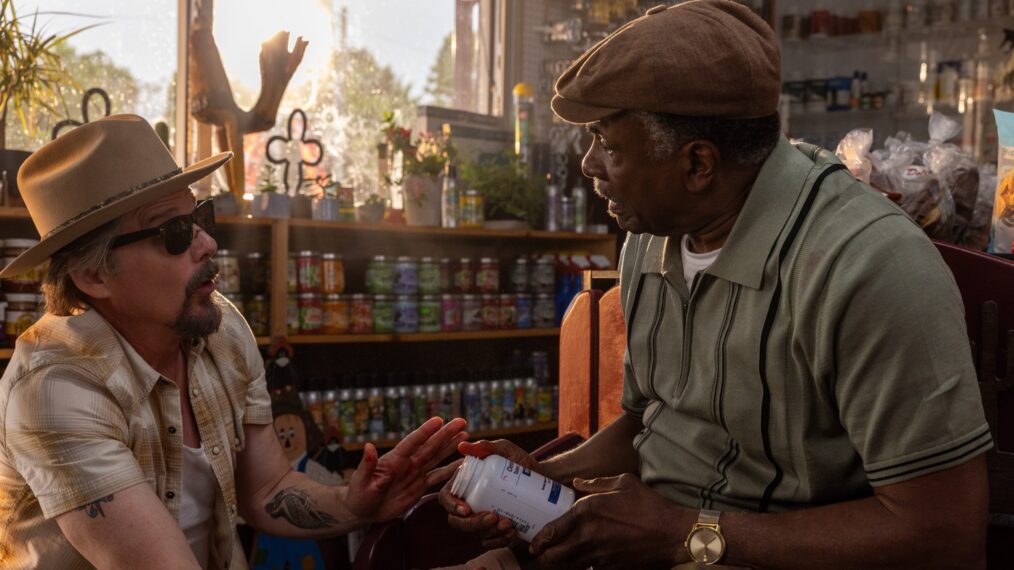
Quick answer: Marty’s new position as managing editor of the Heartland Press puts him between the paper’s need for order and Lee Raybon’s instinct to follow stories wherever they lead. FX’s official Season 2 setup confirms that Keith David’s Marty now runs the newsroom, while Ethan Hawke’s Lee remains a stubborn citizen journalist. That is a natural source of friction—but specific scene-by-scene claims should wait until they can be verified against the episodes.
Editor’s note: This article analyzes the characters and the published Season 2 premise. It does not present unverified dialogue or a scene description as confirmed fact.
Why Marty’s promotion changes the relationship
A newsroom can tolerate a difficult reporter when the reporter is useful. It is a different matter when that reporter’s methods threaten deadlines, legal exposure, relationships with sources, or the publication’s credibility. The official Season 2 synopsis identifies Marty as the Heartland Press’s managing editor, a change that gives him institutional responsibility rather than simply a front-row seat to Lee’s chaos.
That shift matters because Lee is not a conventional employee who waits for an assignment and returns with a neatly packaged story. He calls himself a “truthstorian,” and his drive to uncover corruption repeatedly puts him in trouble. Marty’s challenge is not simply to tell Lee to behave. It is to decide which risks a small newsroom can responsibly take—and which risks could compromise the work itself.
Control versus independence: the real newsroom conflict
The strongest version of this conflict is not “boss versus rebellious reporter.” It is a disagreement over what journalism owes the public. Lee’s approach puts discovery first: follow the lead, question the powerful, and keep digging when the official explanation feels incomplete. Marty’s role requires a second set of questions: What can be verified? What can be published now? Who has been given a fair chance to respond? And what evidence would survive scrutiny after the story goes live?
Those checks are not automatically censorship. At their best, they protect a reporter’s work from avoidable mistakes. But editorial control can become a problem if it is used to shield influential people from legitimate scrutiny. That tension gives the Heartland Press storyline a useful dramatic question: can Marty set boundaries without dulling the very instinct that makes Lee valuable?

Why Keith David is well suited to play the person holding the line
Keith David brings a grounded presence to a character who has to think about consequences while Lee is already chasing the next lead. Marty’s authority is most interesting when it feels earned rather than merely imposed. A managing editor needs to understand the people doing the reporting, but also the wider operation that makes publication possible.
That balance gives David’s role a different kind of tension from Lee’s. Lee tends to move toward a mystery; Marty has to consider what happens after the mystery becomes a published allegation. A compelling scene between them does not need a long argument. A pause, a refusal to sign off, or a pointed question about evidence can reveal how differently they define responsibility.
The prison investigation raises the stakes
FX’s published synopsis says the season’s central case involves a client of public defender Ginger who has gone missing from a state penitentiary. The premise puts Lee’s appetite for investigation in contact with a system where access, records, institutional authority, and the safety of vulnerable people all matter.
For Marty, a prison-related investigation creates a particularly difficult editorial problem. Allegations involving a correctional facility can affect real people and carry serious consequences. The newsroom needs documents, corroboration, precise language, and a clear distinction between what is known and what remains a question. Lee may be right to push hard, but the story will be stronger if the paper can show readers exactly why its conclusions are justified.

What Marty can do that Lee cannot
- Demand corroboration: one source can open a lead, but independent confirmation makes a story more reliable.
- Separate fact from inference: a suspicious timeline is not, by itself, proof of a conspiracy.
- Protect vulnerable sources: details that identify a source should be handled with care, especially when retaliation is possible.
- Give subjects a fair opportunity to respond: the answer—or the lack of one—should be represented accurately.
- Know when to hold publication: a short delay to verify a critical detail can prevent a much larger failure.
These are practical editorial safeguards, not reasons to bury a difficult story. The best editor is neither a rubber stamp nor a gatekeeper protecting powerful interests. The job is to make the reporting more defensible without stripping it of urgency.

What viewers should watch for
Rather than assuming every disagreement means Marty is trying to silence Lee, watch for the reason behind each decision. Is Marty asking for stronger evidence, trying to protect the paper from a preventable legal problem, or responding to outside pressure? Those motives may look similar in a heated exchange, but they mean very different things.
Also watch whether Marty offers a workable alternative. A flat “no” closes the conversation. Asking Lee to find a second source, document a claim, or give a subject a chance to answer keeps the investigation alive while raising its standards. If the series lets both men make reasonable points, their conflict can become more than a familiar boss-and-rebel routine.

The bigger theme: who gets to decide what the public sees?
At its core, this storyline can be read as a question about power inside journalism itself. A reporter needs enough independence to challenge institutions, but independence does not remove the obligation to prove what is published. An editor needs authority to maintain standards, but authority is not a license to suppress inconvenient facts.
That is why Marty’s role may be as important to the Heartland Press as Lee’s investigations. If Marty can keep the paper accountable without making it timid, he can become the person who helps Lee’s reporting land with greater force. If control becomes the goal in itself, the newsroom risks losing the quality that makes it matter. The most interesting outcome is not necessarily one man winning; it is whether the two can build a working relationship that allows difficult truths to be reported responsibly.
Official information and further reading
FX’s official The Lowdown page provides the show’s published Season 2 premise and official video material. For cast details, see the official cast page. These sources establish the characters and premise; they should not be treated as confirmation of unverified episode-specific dialogue.
Read more from our The Lowdown Season 2 coverage for related character analysis and story guides.
Frequently asked questions
Who is Marty in The Lowdown Season 2?
Marty, played by Keith David, is the managing editor of the Heartland Press in the published Season 2 premise.
Why does Marty clash with Lee Raybon?
Lee is an independent-minded citizen journalist who follows stories aggressively, while Marty has responsibility for the newsroom’s standards, publication decisions, and overall operation. Their priorities can naturally conflict.
Is Marty confirmed to try to stop Lee from publishing a specific story?
The official synopsis establishes Marty’s new editorial role and Lee’s investigative approach, but it does not confirm every specific confrontation. Episode-level claims should be checked against the episodes or reliable recaps.
What is the main investigation in Season 2?
FX’s synopsis describes a case involving a public defender’s client who goes missing from a state penitentiary, leading Lee toward questions of power and corruption.
Where can I find official information about The Lowdown?
Visit FX’s official The Lowdown page for the published synopsis, cast information, and official video extras.
Author: Shivam Das